

Updated October 2026. I’m Saizul Amin, a digital growth and web systems professional working on websites and SEO since 2017. I have rewritten this guide from scratch with practical steps, tested advice and sources, and I will keep it current. Last reviewed: October 2026.
A digital marketing strategy is a plan for how you will attract the right people online and turn them into customers, using your limited time and money. Most small businesses do not fail because they chose the wrong platform; they fail because they have no plan, spread themselves across every channel, and never measure anything. This guide gives you a simple, repeatable process.
For definitions and an overview of the channels, see what is digital marketing, and for the planning document itself, how to write a marketing plan.
Step 1: Set goals you can measure
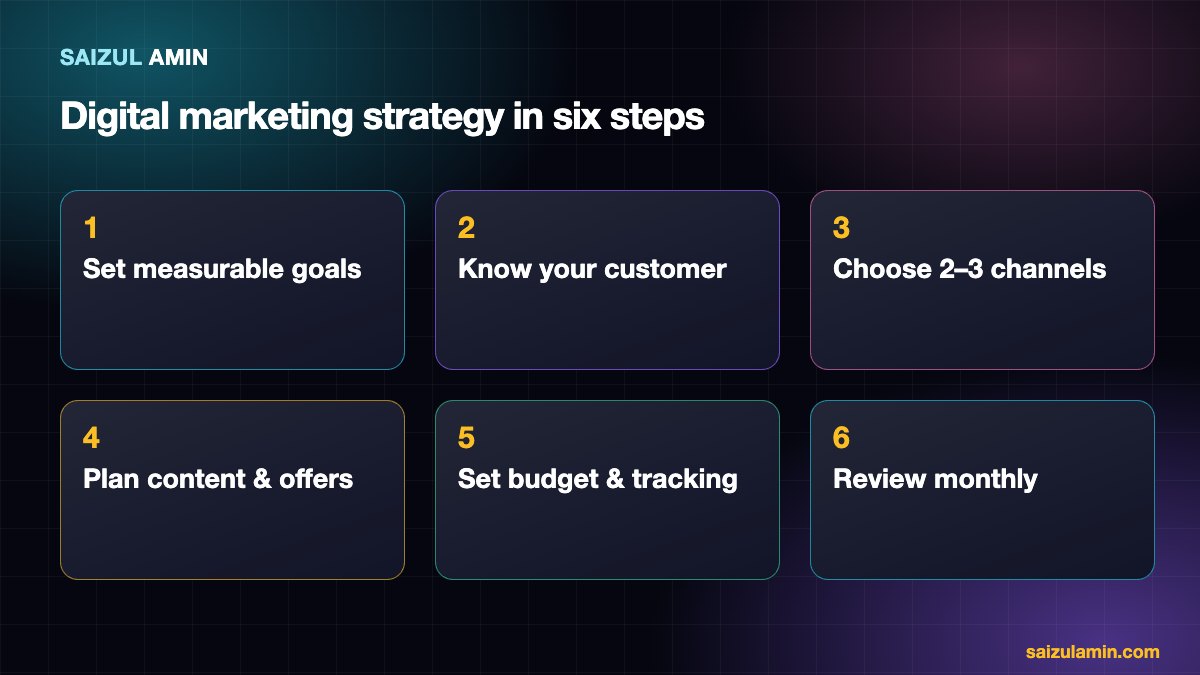
“More visibility” is not a goal. “Generate 30 qualified enquiries a month within six months” is. Tie goals to business outcomes (leads, sales, bookings) and to numbers you can track. Work backwards: if 1 in 10 enquiries becomes a customer and you want 6 new customers, you need 60 enquiries.
Step 2: Know the customer
- Who exactly buys from you, and what triggers them to look?
- What questions do they ask before buying? These become your content topics.
- Where do they spend time: Google, Facebook, WhatsApp, LinkedIn, YouTube?
- What makes them hesitate (price, trust, timing)?
Talk to five recent customers. It is the cheapest research available.
Step 3: Choose two or three channels
| Channel | Best for | Speed |
|---|---|---|
| SEO and content | People actively searching for solutions | Slow, compounding |
| Paid search and social ads | Fast tests, specific offers | Fast, stops when you stop paying |
| Social media | Awareness, community, proof | Medium |
| Email marketing | Nurturing leads and repeat sales | Medium, high return |
| Local listings (Google Business Profile) | Local services | Fast and cheap |
| Partnerships and referrals | Trust-based services | Medium |
Pick the two or three where your customers are and where you can be consistent. Doing three channels well beats seven badly.
Step 4: Make a clear offer and plan content
- State what you do, for whom, and the result, in one sentence.
- Create content for each stage: awareness (useful guides), consideration (comparisons, case studies) and decision (pricing, FAQs, testimonials).
- Give every piece of content a next step: read this, subscribe, book a call.
- Build a website that converts: fast, clear, and with one main action. See my conversion rate optimization framework.
Step 5: Set a budget and tracking
- Decide what you can invest per month in tools, ads and content, and what the time is worth.
- Set up Google Analytics 4 with key events, Google Search Console, and a simple spreadsheet of leads by source.
- Track cost per lead and cost per customer, not just clicks.
A 90-day roadmap
- Days 1–30 (foundation): fix the website basics, set up tracking and listings, define the offer, build the first key pages and an email capture.
- Days 31–60 (launch): publish core content, start your chosen channels, run a small paid test if relevant.
- Days 61–90 (optimise): review data, double down on what works, cut what does not, improve conversion.
Step 6: Review monthly
Once a month, answer: what did we do, what happened, what did we learn, and what will we change? Keep a one-page dashboard: traffic, leads, conversion rate, cost per lead and customers won.
Mistakes to avoid
- Starting with tactics (“we need TikTok”) instead of goals.
- Changing strategy every few weeks before anything can work.
- Counting likes and followers instead of leads.
- Ignoring the follow-up: slow replies lose leads you paid to get.
Need a second pair of eyes?
If you would like help applying this to your own website, send me a message with your site address and goal. I will tell you honestly what I would do first.
Frequently asked questions
How much should a small business spend on digital marketing?
It depends on margins and goals. Start with an amount you can sustain for at least three months and judge by cost per lead.
Which channel should I start with?
Start where your customers already look for you: Google for services people search, social or WhatsApp where the conversation happens.
How long until I see results?
Paid channels can bring leads in days; SEO and content take months but compound.
Should I hire an agency?
If you lack time or skills, a good specialist can speed things up. Ask for a clear scope, reporting and no long lock-in.
Sources and further reading
How this article was written
I wrote this guide from hands-on experience with websites, SEO and automation. Technical and policy details were checked against the official sources above in October 2026. Tools, policies and prices change; if you notice something out of date, email info@saizul.com and I will correct it. Examples reflect my own projects and will vary on yours.

Saizul Amin is a digital growth strategist and SEO consultant specialising in search engine optimisation, web development, AI-powered automation, and online income systems. With 8 years of hands-on experience helping businesses and individual creators grow their online presence, Saizul combines technical expertise with practical, results-driven strategy.
Experience & Background
Saizul started his digital career in 2017, initially working with Bioscope Limited to build and optimise websites for organic search traffic. Over the years, he has worked across industries including DGHS, NAVANA, UNICampus, UNIPathways, UniqueMark, developing a deep understanding of what it takes to rank, convert, and grow sustainably online.
His work spans the full digital stack — from technical SEO audits and content strategy to WordPress development, marketing automation, and AI tool integration for small businesses and startups.
What He Covers on This Blog
Every article on SaizulAmin.com is written from direct experience. Saizul does not publish theoretical content — every guide, tool recommendation, and strategy shared here has been tested and applied in real projects. Topics include:
- Search engine optimisation (on-page, technical, and content SEO)
- Digital marketing strategy and growth systems
- AI tools and automation for business productivity
- Web development, WordPress, and website building
- Making money online through freelancing and affiliate marketing
Why Trust This Content
All recommendations on this site reflect tools and strategies Saizul actively uses or has personally evaluated. Where affiliate relationships exist, they are clearly disclosed. Content is regularly reviewed and updated to reflect current best practices and algorithm changes.