

Updated October 2026. I’m Saizul Amin, a digital growth and web systems professional working on websites and SEO since 2017. I have rewritten this guide from scratch with practical steps, tested advice and sources, and I will keep it current. Last reviewed: October 2026.
Conversion rate optimization (CRO) means getting more of the people who already visit your site to take the action you want: buy, call, book or subscribe. It is often cheaper than buying more traffic. But most CRO advice assumes thousands of visitors a day and endless testing. Most small sites do not have that, so this framework focuses on what works with modest traffic.
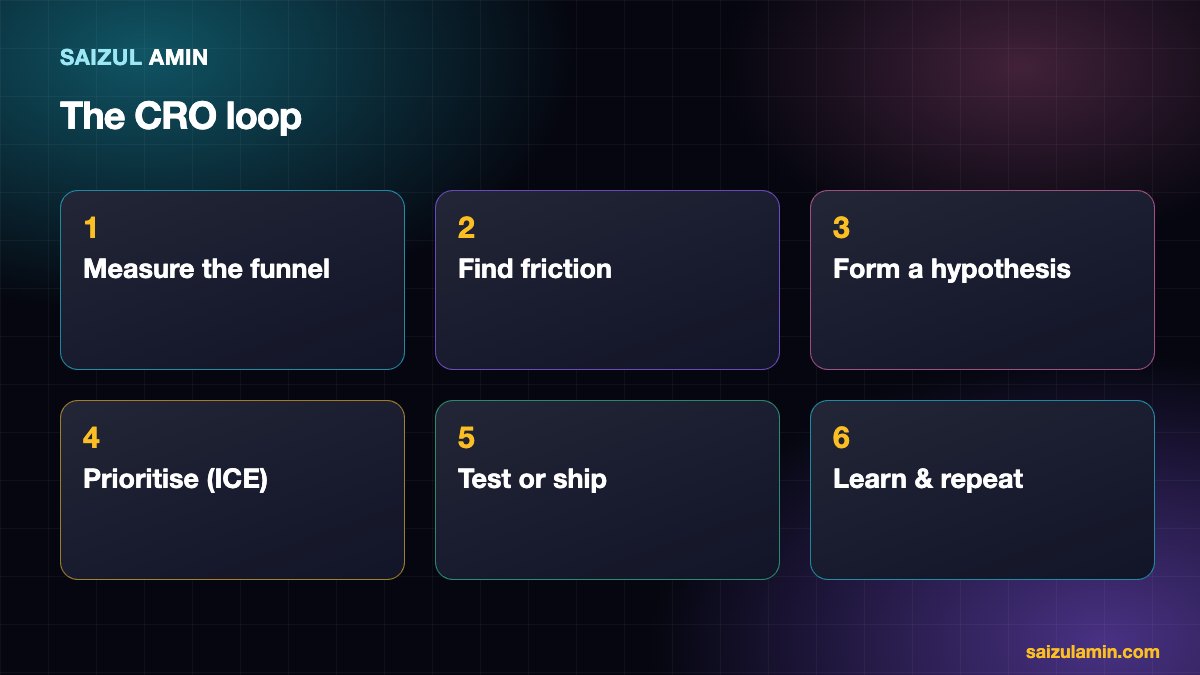
Step 1: Define one conversion and measure the funnel
Pick the primary action for each key page (for a service business: a contact request; for a shop: a purchase). Set it up as a key event in Google Analytics 4 (see Google’s GA4 key events help). Then look at the path: landing page → next step → form → success. Where do most people drop off? That is where to work.
Conversion rate = conversions ÷ visitors. Segment it by device, source and landing page, because averages hide problems (mobile often converts far worse than desktop).
Step 2: Find the friction
- Session recordings and heatmaps: free tools such as Microsoft Clarity show where people hesitate, rage-click or leave.
- Real feedback: a one-question poll, support emails and what sales calls reveal about objections.
- Speed: slow pages lose people before they read anything. See my speed optimization guide and Google’s Core Web Vitals.
- Your own device: complete the journey on a phone with a slow connection.
Step 3: Fix the basics before testing anything
Small sites usually gain more from fixing obvious problems than from A/B testing button colours.
| Area | What to check |
|---|---|
| Clarity | Within five seconds, can a new visitor tell what you offer, for whom and what to do next? |
| One main call to action | One clear primary button per page, repeated at natural points |
| Trust | Real names, photos, case studies, reviews you can verify, clear contact details |
| Forms | Ask only for what you need; fewer fields almost always helps; make errors clear |
| Mobile | Tap targets large enough; no overlapping pop-ups; readable text |
| Speed | Fast to first view; no layout jumps |
| Objections | Answer price, timeline and risk questions on the page (FAQs help) |
When I redesigned the site for my own agency, x-bd.com, I applied exactly this: one primary action (a free audit), repeated in the header, hero and footer, a contact form with only the fields we needed, honest “starting from” prices instead of vague quotes, and a WhatsApp option for people who prefer chat.
Step 4: Write a hypothesis, not a hunch
Use this format: Because [evidence], we believe that [change] will [result], which we will measure by [metric]. Example: “Because recordings show people stalling on the 8-field form, we believe that cutting it to 4 fields will increase submissions.”
Step 5: Prioritise with ICE
Score each idea from 1 to 10 on Impact, Confidence (how strong is the evidence?) and Ease, then multiply or average. Do high scores first. Cheap, well-evidenced fixes should simply be shipped; reserve formal tests for uncertain, high-impact changes.
Step 6: Testing without fooling yourself
- Traffic matters. With low traffic, a test may need weeks to detect anything but a large change. Test bold changes, not tiny ones.
- Decide the duration and metric before starting; do not stop the moment the numbers look good.
- Run tests for at least full weeks to cover weekday and weekend behaviour.
- Change one major thing at a time, or you will not know what worked.
- If you cannot test, use before/after comparison carefully and record everything else that changed.
Common CRO mistakes
- Copying another company’s “winning” layout.
- Optimising for clicks instead of real outcomes (qualified leads, sales).
- Using dark patterns (fake urgency, hidden costs). They may lift short-term numbers but harm trust and can break rules.
- Ignoring the quality of traffic: sending the wrong audience to a page cannot be fixed by design.
Need a second pair of eyes?
If you would like help applying this to your own website, send me a message with your site address and goal. I will tell you honestly what I would do first.
Frequently asked questions
What is a good conversion rate?
It varies hugely by industry, traffic source and price. Compare your own page to its past performance and segments rather than to a universal benchmark.
How much traffic do I need for A/B testing?
Enough to reach a reliable result in a reasonable time. For small sites, fix the obvious issues first and test only big changes.
Which tools do I need?
Google Analytics 4 and a free session-recording tool are enough to start.
Does SEO traffic convert?
Often well, because searchers have intent, but only if the page matches their need. See my SEO roadmap.
Sources and further reading
How this article was written
I wrote this guide from hands-on experience with websites, SEO and automation. Technical and policy details were checked against the official sources above in October 2026. Tools, policies and prices change; if you notice something out of date, email info@saizul.com and I will correct it. Examples reflect my own projects and will vary on yours.

Saizul Amin is a digital growth strategist and SEO consultant specialising in search engine optimisation, web development, AI-powered automation, and online income systems. With 8 years of hands-on experience helping businesses and individual creators grow their online presence, Saizul combines technical expertise with practical, results-driven strategy.
Experience & Background
Saizul started his digital career in 2017, initially working with Bioscope Limited to build and optimise websites for organic search traffic. Over the years, he has worked across industries including DGHS, NAVANA, UNICampus, UNIPathways, UniqueMark, developing a deep understanding of what it takes to rank, convert, and grow sustainably online.
His work spans the full digital stack — from technical SEO audits and content strategy to WordPress development, marketing automation, and AI tool integration for small businesses and startups.
What He Covers on This Blog
Every article on SaizulAmin.com is written from direct experience. Saizul does not publish theoretical content — every guide, tool recommendation, and strategy shared here has been tested and applied in real projects. Topics include:
- Search engine optimisation (on-page, technical, and content SEO)
- Digital marketing strategy and growth systems
- AI tools and automation for business productivity
- Web development, WordPress, and website building
- Making money online through freelancing and affiliate marketing
Why Trust This Content
All recommendations on this site reflect tools and strategies Saizul actively uses or has personally evaluated. Where affiliate relationships exist, they are clearly disclosed. Content is regularly reviewed and updated to reflect current best practices and algorithm changes.