

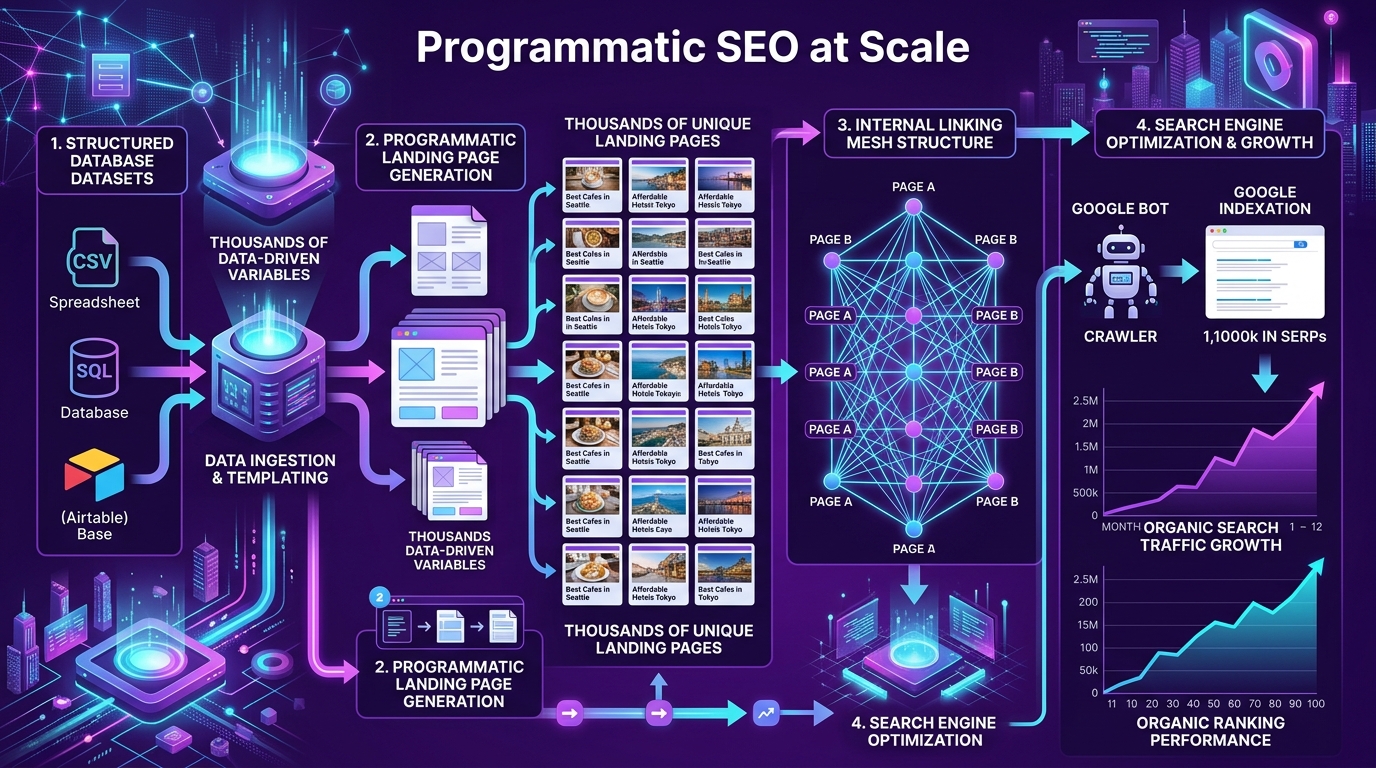
Writing organic blog articles one by one is an effective long-term strategy, but it cannot scale to capture tens of thousands of long-tail commercial queries. High-growth technology giants like NomadList, Zapier, TripAdvisor, and Wise achieved billions of organic impressions through a systematic engineering discipline: Programmatic SEO (pSEO).
Programmatic SEO is the practice of designing structured database datasets and code templates to automatically generate thousands of distinct, search-intent-optimized landing pages. However, in 2026, executing pSEO carelessly with generic AI filler will trigger immediate Google Helpful Content and Thin Content penalties. In this engineering manifesto, we explore how to build resilient, high-information-gain programmatic architectures that search engines reward with top rankings.
| Dimension | Spammy AI Programmatic (Penalized) | Engineering-Led pSEO (High Authority) |
|---|---|---|
| Data Source | Rehashed ChatGPT text prompts | Proprietary databases, public APIs & custom research |
| Page Uniqueness | Spun text with changed city/keyword | Unique data charts, filtered tables & local stats |
| Search Intent | Vague informational filler | Direct transaction or comparison fulfillment |
| Internal Linking | Orphaned pages or flat lists | Hierarchical semantic mesh architecture |
| Indexation Rate | < 15% (Crawled – currently not indexed) | 85%+ healthy indexation in Google Search Console |
1. The Anatomy of a High-Performing Programmatic Formula
Programmatic SEO works exclusively when user queries follow predictable, repetitive search syntax across a scalable dimension:
Formula 1 (Location-Based): [Service / Feature] in [City / Country]
Examples: "Coworking spaces in Lisbon", "Tech recruiters in Austin"

Formula 2 (Integration-Based): How to connect [Software A] with [Software B]
Examples: "Connect Stripe to Airtable", "Sync Shopify with QuickBooks"

Formula 3 (Comparative / Alternative): [Product A] vs [Product B]
Examples: "Notion vs Obsidian", "Airtable alternatives for Mac"
2. Curating and Structuring High-Value Datasets
The foundation of programmatic SEO is not the writing; it is the underlying database. If your database contains only two columns (City and Description), your pages will look identical and search engines will de-index them within weeks. A production dataset must contain rich, multi-dimensional attributes:
{
  "slug": "berlin",
  "city_name": "Berlin",
  "country": "Germany",
  "avg_monthly_cost_usd": 2450,
  "internet_speed_mbps": 110,
  "coworking_space_count": 84,
  "safety_score_out_of_10": 8.7,
  "top_neighborhoods": ["Mitte", "Kreuzberg", "Prenzlauer Berg"],
  "curated_cafes": [
    { "name": "The Barn", "has_wifi": true, "socket_availability": "High" }
  ]
}
3. Avoiding Google’s Thin Content Algorithmic Filter
To pass Google’s Quality Rater Guidelines and Information Gain thresholds, each programmatic page must satisfy three criteria:
- Interactive UI Elements: Include filterable tables, interactive pricing calculators, or dynamic maps rather than static walls of text.
- Proprietary Calculations: Compute unique summary metrics (e.g., “Cost of Living Index” or “Engineer Salary to Rent Ratio”) that exist nowhere else on the internet.
- Dynamic Schema Markup: Generate customized JSON-LD structured data (e.g.,
LocalBusiness,Product, orSoftwareApplication) reflecting the specific parameters of that row.
4. The Semantic Mesh Internal Linking Architecture
If you publish 2,000 new pages with no internal linking, Googlebot will never discover or crawl them. Implement a hierarchical semantic mesh:
           [ Root Hub: Coworking Directory ]
                          │
         ┌────────────────┴────────────────┐
         ▼                                 ▼
[ Regional Hub: Europe ]          [ Regional Hub: North America ]
         │                                 │
   ┌─────┴─────┐                     ┌─────┴─────┐
   ▼           ▼                     ▼           ▼
[ Berlin ]  [ Lisbon ]            [ Austin ]  [ Toronto ]
   ▲           ▲                     ▲           ▲
   └───────────┴─ Related Cities ────┴───────────┘
Every programmatic page must link back to its parent category hub, sibling entities (e.g., “Other digital nomad hubs in Germany”), and relevant contextual articles.
Frequently Asked Questions (FAQ)
Should I publish all 1,000+ programmatic pages simultaneously?
No. Blasting thousands of pages on a brand-new domain with zero crawl budget triggers spam alarms. Publish a curated batch of 50–100 high-priority pages first. Monitor indexation rates and impressions in Google Search Console, and roll out subsequent batches gradually.
What CMS or tech stack is best for Programmatic SEO?
For enterprise performance, headless architectures like Next.js / Astro with Static Site Generation (SSG) connected to Supabase or PostgreSQL offer the fastest TTFB. For WordPress, custom post types paired with WP All Import Pro or custom REST API scripts provide reliable scaling.
Need senior technical guidance architecting an enterprise programmatic SEO pipeline or building dataset-driven landing page engines? Discover our SEO casework or reach out for strategic consulting.

Saizul Amin is a digital growth strategist and SEO consultant specialising in search engine optimisation, web development, AI-powered automation, and online income systems. With 8 years of hands-on experience helping businesses and individual creators grow their online presence, Saizul combines technical expertise with practical, results-driven strategy.
Experience & Background
Saizul started his digital career in 2017, initially working with Bioscope Limited to build and optimise websites for organic search traffic. Over the years, he has worked across industries including DGHS, NAVANA, UNICampus, UNIPathways, UniqueMark, developing a deep understanding of what it takes to rank, convert, and grow sustainably online.
His work spans the full digital stack — from technical SEO audits and content strategy to WordPress development, marketing automation, and AI tool integration for small businesses and startups.
What He Covers on This Blog
Every article on SaizulAmin.com is written from direct experience. Saizul does not publish theoretical content — every guide, tool recommendation, and strategy shared here has been tested and applied in real projects. Topics include:
- Search engine optimisation (on-page, technical, and content SEO)
- Digital marketing strategy and growth systems
- AI tools and automation for business productivity
- Web development, WordPress, and website building
- Making money online through freelancing and affiliate marketing
Why Trust This Content
All recommendations on this site reflect tools and strategies Saizul actively uses or has personally evaluated. Where affiliate relationships exist, they are clearly disclosed. Content is regularly reviewed and updated to reflect current best practices and algorithm changes.