





Updated October 2026. I’m Saizul Amin, a digital growth and web systems professional working on websites and SEO since 2017. I have rewritten this guide from scratch with practical steps, tested advice and sources, and I will keep it current. Last reviewed: October 2026.
Content marketing is not “publish more”. It is building a library that helps a specific audience so well that they find you, trust you and eventually buy from you. Done well, each piece makes the others stronger. Done badly, you end up with hundreds of overlapping pages that compete with each other.
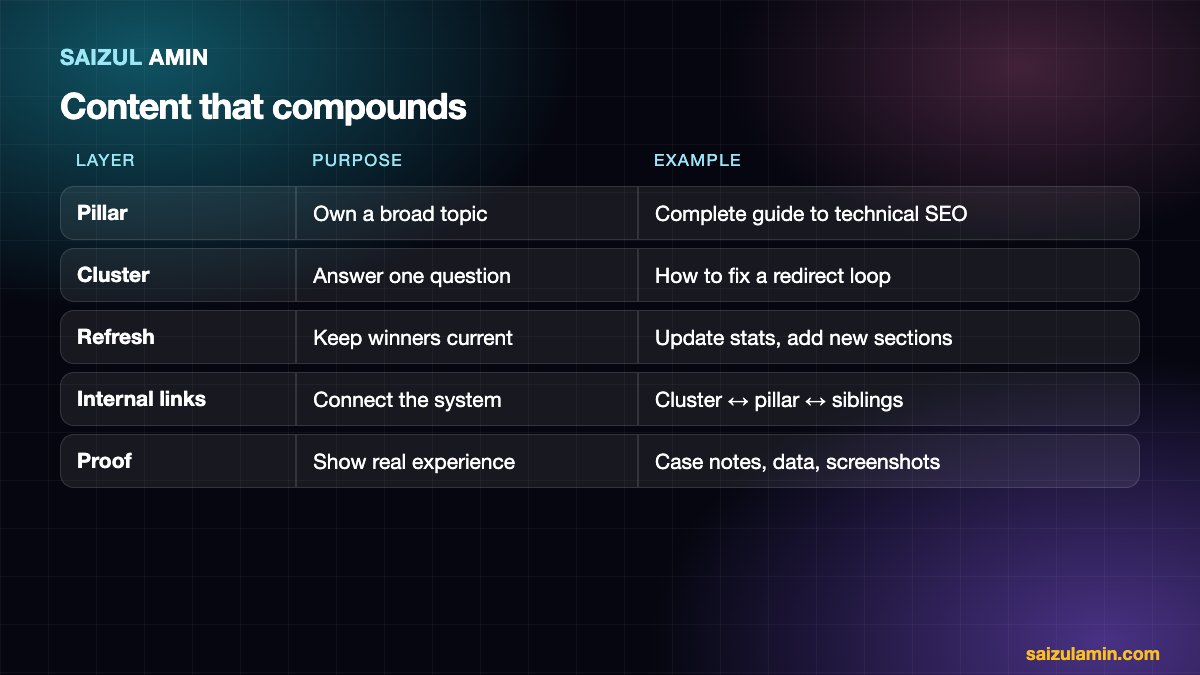
The clearest lesson I have had came from planning the recovery of a UK education site with about 600 articles whose traffic had fallen. The problems were duplicate-intent articles, weak internal linking, no pillar structure and stale content. The fix was structural: about 20 pillar articles, 10 to 20 cluster articles beneath each, refreshing the 100 best existing articles and a strict linking model. That method is below.

Step 1: Define audience and goal
Write one sentence for each: who you help, what problem they search for, and what action you want (subscribe, request a quote, buy). Every piece of content should serve that sentence.
Step 2: Choose 3 to 6 themes you can own
Pick themes where you have real knowledge and where people actually search. Avoid spreading across unrelated topics; a site about everything signals expertise in nothing. Check demand with Search Console, autocomplete and a keyword tool, and look at what already ranks.
Step 3: Create pillar pages
A pillar is a definitive guide on a broad topic: comprehensive, well structured and updated regularly. It should answer the main question quickly and then link to deeper articles. Write the pillars first, because they define the structure.
Step 4: Fill with cluster content
Each cluster targets one specific question or long-tail query inside the theme. One keyword per article: two articles for the same query will compete (cannibalisation). Before writing, check whether an existing page already covers it; if so, improve that page instead.
Step 5: Link the system
- Cluster → link to its pillar.
- Pillar → link to every cluster.
- Cluster → link to two or three related clusters.
- Use descriptive anchor text.
Step 6: Make every piece worth reading
- Lead with the answer; add depth for those who want it.
- Include something original: your data, examples, screenshots, diagrams, mistakes and lessons.
- Show who wrote it and why they are qualified, and cite primary sources.
- Edit hard. Cut filler and repetition.
Google’s people-first content guidance is a good checklist for this.
Step 7: Distribute, not just publish
- Share where your audience already spends time (communities, LinkedIn, email newsletter).
- Turn a strong article into a short video, a checklist, a slide deck or an email series.
- Internally link new articles from existing relevant ones the day you publish.
Step 8: Refresh before you write more
Often the best use of a week is updating your top ten articles: new facts, better examples, fixed links, an improved introduction and title. Improving a page that already ranks on page two is usually faster than a new post.
Step 9: Measure what matters
| Metric | Where | Use |
|---|---|---|
| Impressions, clicks, queries, position | Search Console | Find pages close to page one and queries you did not target |
| Engagement and conversions from content | GA4 | Which articles lead to real outcomes |
| Subscribers and enquiries | Your CRM or email tool | Business impact |
| Links and mentions | Search Console links report | Authority |
A simple publishing rhythm
Quality beats frequency. A sustainable rhythm is usually one excellent article every one to two weeks, plus a monthly refresh of older ones. Keep a spreadsheet of topics, target keywords, status, links to add and last update date.
Need a second pair of eyes?
If you would like help applying this to your own website, send me a message with your site address and goal. I will tell you honestly what I would do first.
Frequently asked questions
How long until content marketing works?
Typically several months of consistent, useful publishing before results compound. It is a long game.
How many articles should I publish?
As many as you can make genuinely useful. A smaller library of excellent, linked articles beats a large library of thin ones.
Should I delete old, weak content?
Improve what has potential, merge duplicates, and remove (with redirects) what cannot be improved. See my SEO roadmap for the process.
Can I use AI to create content?
As an assistant, yes. Publish only what a knowledgeable person has reviewed, corrected and enriched with real experience.
Sources and further reading
- Google: Creating helpful, people-first content
- Google Search Central: SEO Starter Guide
- Google Search Console
How this article was written
I wrote this guide from hands-on experience with websites, SEO and automation. Technical and policy details were checked against the official sources above in October 2026. Tools, policies and prices change; if you notice something out of date, email info@saizul.com and I will correct it. Examples reflect my own projects and will vary on yours.


Saizul Amin is a digital growth strategist and SEO consultant specialising in search engine optimisation, web development, AI-powered automation, and online income systems. With 8 years of hands-on experience helping businesses and individual creators grow their online presence, Saizul combines technical expertise with practical, results-driven strategy.
Experience & Background
Saizul started his digital career in 2017, initially working with Bioscope Limited to build and optimise websites for organic search traffic. Over the years, he has worked across industries including DGHS, NAVANA, UNICampus, UNIPathways, UniqueMark, developing a deep understanding of what it takes to rank, convert, and grow sustainably online.
His work spans the full digital stack — from technical SEO audits and content strategy to WordPress development, marketing automation, and AI tool integration for small businesses and startups.
What He Covers on This Blog
Every article on SaizulAmin.com is written from direct experience. Saizul does not publish theoretical content — every guide, tool recommendation, and strategy shared here has been tested and applied in real projects. Topics include:
- Search engine optimisation (on-page, technical, and content SEO)
- Digital marketing strategy and growth systems
- AI tools and automation for business productivity
- Web development, WordPress, and website building
- Making money online through freelancing and affiliate marketing
Why Trust This Content
All recommendations on this site reflect tools and strategies Saizul actively uses or has personally evaluated. Where affiliate relationships exist, they are clearly disclosed. Content is regularly reviewed and updated to reflect current best practices and algorithm changes.


