

A site with hundreds of pages generated from a template (calculators, converters, file tools) is the classic programmatic SEO setup. Done well it can serve millions of useful searches; done badly it is exactly what Google’s “scaled content” spam policy targets. I run ShobFree, a platform with 302 tool pages in English and Bangla, so this is the framework I use to keep scale and quality together.
The rule: each page must deserve to exist
Google’s spam policies penalise producing many pages mainly to manipulate rankings. The test is not “generated or handwritten”, it is “does this page help someone better than alternatives?” A working Compress PDF tool does; fifty near-identical “compress PDF for X” pages do not.
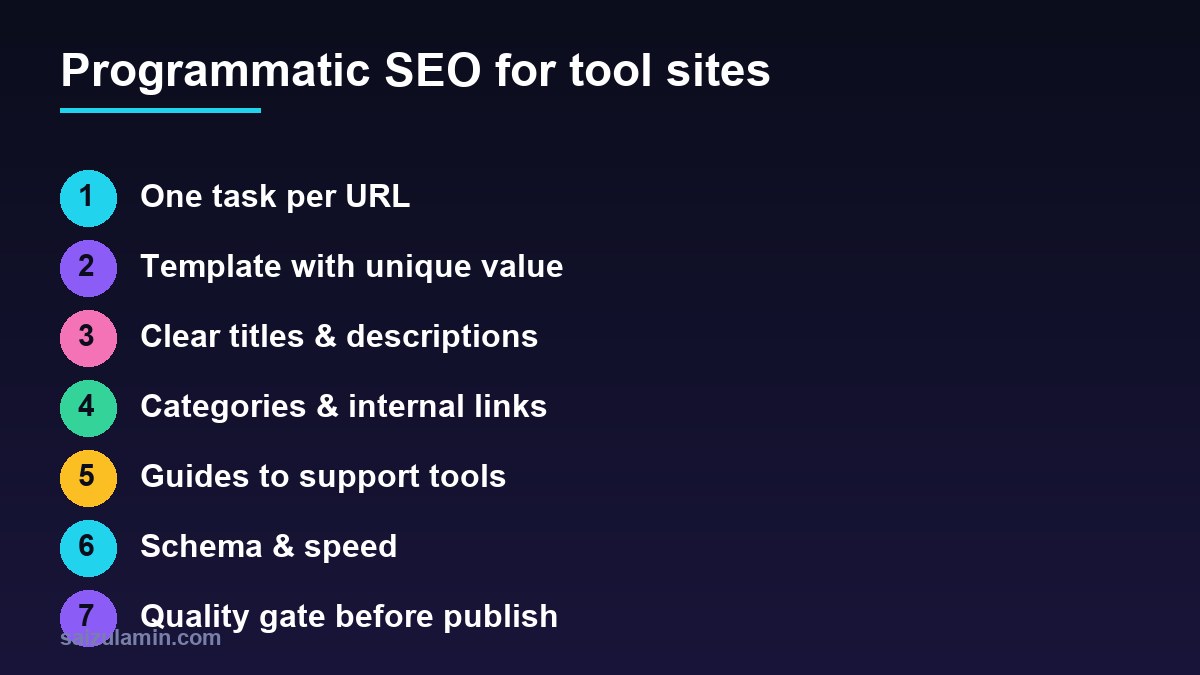
1. One task, one URL
Map real tasks to real searches: /compress-pdf, /merge-pdf, /bmi-calculator. Keep URLs short and human. Merge near-duplicate intents into one stronger page rather than splitting them.
2. A template that carries unique value
Every tool page should include more than the widget:
- A one-sentence promise above the tool.
- “How it works” in three steps.
- Explanation of options and limits (file size, formats, quality levels).
- Privacy note (what happens to files).
- Related tools and a short FAQ written for that tool.
Boilerplate is fine for structure; the explanations, examples and FAQs must differ per tool.
3. Titles and descriptions that match intent
Lead with the task and the benefit, e.g. “Compress PDF to 1 MB or Less, Free”, and keep descriptions specific (“merge, split, compress and convert PDF, no sign-up, files deleted automatically”). Generate them from fields, then review the top 50 pages by hand.
4. Site architecture and internal links
- Group tools in categories with their own hub pages (Organize PDF, Optimize PDF, Image tools…).
- Add breadcrumbs (Home › Category › Tool).
- Link related tools on each page and popular tools from the home page.
- Keep important tools within three clicks of home.
5. Support the tools with real guides
Tool pages answer “do it” searches. Guides answer “how / why / which” searches (“how to compress a PDF for an online application”) and link naturally to the tool. They also supply the experience and depth that tool pages cannot.
6. Structured data and speed
Use appropriate markup (breadcrumbs everywhere; software application or FAQ where it fits and the content is truly on the page). Keep Core Web Vitals strong: server-render the page, lazy-load below the fold and avoid heavy scripts. See my speed optimization guide for the techniques.
7. Languages
If you offer Bangla and English, use separate URLs per language, link them with hreflang, and write real localised copy rather than machine-translating titles.
Quality gate before publishing
| Check | Pass condition |
|---|---|
| Does the tool work on mobile? | Tested on a real phone |
| Is the explanation unique? | Not a swap of one keyword |
| Would you use this page? | Yes, honestly |
| Is it indexable and fast? | Passes Search Console and Lighthouse checks |
| Any near-duplicate? | Merge or noindex |
Measure and prune
In Search Console, watch indexing, impressions and clicks per page type. Improve pages that rank on page two, consolidate those that never get impressions, and remove what cannot be made useful. Pruning is part of the process, as I describe in the SEO roadmap.
Need help applying this to your site?
I work on technical SEO, performance and web systems for businesses and product teams. Send me your site address and goal and I will tell you what I would fix first.
FAQ
Is programmatic SEO against Google’s rules?
No. Using templates is fine. Publishing large numbers of low-value pages to manipulate rankings is not.
How many tool pages should I launch?
Launch the ones you can make genuinely good, then expand based on demand and quality.
Do I need a blog?
It helps: guides capture informational searches and build trust.
Sources
- Google Search spam policies (scaled content abuse)
- Google: Creating helpful, people-first content
- Google: Software app structured data
- web.dev: Core Web Vitals

Saizul Amin is a digital growth strategist and SEO consultant specialising in search engine optimisation, web development, AI-powered automation, and online income systems. With 8 years of hands-on experience helping businesses and individual creators grow their online presence, Saizul combines technical expertise with practical, results-driven strategy.
Experience & Background
Saizul started his digital career in 2017, initially working with Bioscope Limited to build and optimise websites for organic search traffic. Over the years, he has worked across industries including DGHS, NAVANA, UNICampus, UNIPathways, UniqueMark, developing a deep understanding of what it takes to rank, convert, and grow sustainably online.
His work spans the full digital stack — from technical SEO audits and content strategy to WordPress development, marketing automation, and AI tool integration for small businesses and startups.
What He Covers on This Blog
Every article on SaizulAmin.com is written from direct experience. Saizul does not publish theoretical content — every guide, tool recommendation, and strategy shared here has been tested and applied in real projects. Topics include:
- Search engine optimisation (on-page, technical, and content SEO)
- Digital marketing strategy and growth systems
- AI tools and automation for business productivity
- Web development, WordPress, and website building
- Making money online through freelancing and affiliate marketing
Why Trust This Content
All recommendations on this site reflect tools and strategies Saizul actively uses or has personally evaluated. Where affiliate relationships exist, they are clearly disclosed. Content is regularly reviewed and updated to reflect current best practices and algorithm changes.