





Updated October 2026. I’m Saizul Amin, a digital growth and web systems professional working on websites and SEO since 2017. I have rewritten this guide from scratch with practical steps, tested advice and sources, and I will keep it current. Last reviewed: October 2026.
Most “make money with a website” advice sells a dream. The truth is simpler and less exciting: a website earns money when it solves a real problem for a real audience, and when you choose a revenue model that matches that audience. This guide compares six models honestly, including what each one demands before it pays.
I run content sites and build websites for businesses, and I manage Google AdSense on several sites. I make no income promises here, because results depend on your topic, your audience and your effort.

Before you pick a model: the three foundations
- A specific audience and problem. “Everyone interested in tech” is not an audience. “Small shop owners in Bangladesh who want an online store” is.
- Content that is genuinely useful. Google’s helpful content guidance is the standard for search traffic, and traffic is what most models run on.
- Trust. An About page, a Contact page, a privacy policy and honest disclosures. Visitors and ad networks both look for them.
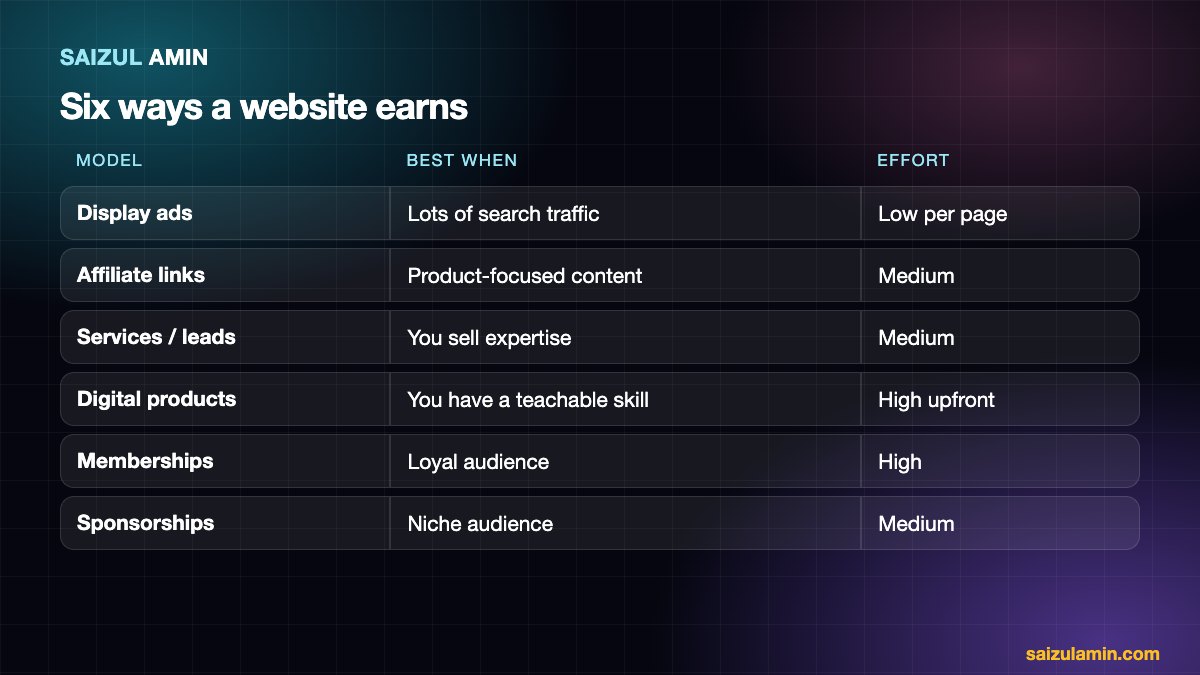
1. Display advertising (Google AdSense and similar)
You show ads and are paid per impression or click. It is the most passive model, but income per visitor is small, so you need meaningful traffic. Approval requires original content and compliance with the program policies; I wrote a full AdSense approval checklist. Keep ads from overwhelming content, and never click your own ads.
2. Affiliate marketing
You recommend products and earn a commission when readers buy through your link. It works best with honest reviews, comparisons and tutorials where you have actually used the product. Disclose affiliate relationships clearly (the US FTC and other regulators require it), and read each program’s terms. See affiliate marketing for beginners.
3. Services and lead generation
The website exists to win clients for something you do: web design, SEO, consulting, photography, accounting. This is often the fastest model to earn real money because one client can be worth far more than thousands of ad impressions. What matters here is trust: case studies, clear services, pricing guidance, testimonials you can verify and an easy way to get in touch.
4. Digital products
E-books, templates, courses, presets, software. High margin and scalable, but the work comes first: you need an audience or a distribution channel and a product that is clearly better than free alternatives. Validate demand before you build (a waiting list or a pilot cohort).
5. Memberships and subscriptions
Paid access to a community, premium content or tools. Recurring revenue is attractive, but you must keep delivering value every month. It suits an audience that already trusts you.
6. Sponsorships and partnerships
Brands pay to reach a focused audience through sponsored posts, newsletter placements or partnerships. A small but highly relevant audience can be worth more to the right sponsor than a big generic one. Label sponsored content clearly.
How to choose
| If you have… | Start with… |
|---|---|
| A professional skill and no audience yet | Services / lead generation |
| Strong search-optimised educational content | Ads, then affiliate |
| Hands-on product knowledge | Affiliate reviews and comparisons |
| A repeatable method you can teach | Digital product or course |
| A loyal community or newsletter | Membership or sponsorships |
Many sites combine two or three models. Just do not add so many monetisation elements that the experience suffers.
A realistic path from zero
- Choose a niche where you have real knowledge.
- Build a fast, clean site (WordPress is a sound choice; see how to create a WordPress site).
- Publish a focused set of excellent, original articles and the trust pages.
- Get found: basic SEO, Search Console, and sharing where your audience already is.
- Add one revenue model, measure it, then improve before adding another.
Mistakes that kill sites before they earn
- Publishing hundreds of thin, similar articles instead of fewer strong ones.
- Copying or spinning other people’s content.
- Joining get-rich-quick traffic schemes or buying fake traffic.
- Hiding affiliate links or sponsored content.
- Quitting after two months. Most content sites take many months to gain traction.
Need a second pair of eyes?
If you would like help applying this to your own website, send me a message with your site address and goal. I will tell you honestly what I would do first.
Frequently asked questions
How much can a website earn?
From nothing to a full-time income. It depends entirely on niche, traffic, trust and model. Be wary of anyone promising specific amounts.
How long until a website makes money?
Service-based sites can win a first client within weeks; content-driven income typically takes many months of consistent work.
Can I start with no money?
You can start with very little: a domain and basic hosting, or even a free static host. Your time and skill are the real investment.
Which model is best for beginners?
If you have a marketable skill, services. If you want to build an audience first, helpful content with ads or affiliate income later.
Sources and further reading
- Google AdSense Program policies
- FTC: Disclosures 101 for Social Media Influencers
- Google: Creating helpful, people-first content
How this article was written
I wrote this guide from hands-on experience with websites, SEO and automation. Technical and policy details were checked against the official sources above in October 2026. Tools, policies and prices change; if you notice something out of date, email info@saizul.com and I will correct it. Examples reflect my own projects and will vary on yours.


Saizul Amin is a digital growth strategist and SEO consultant specialising in search engine optimisation, web development, AI-powered automation, and online income systems. With 8 years of hands-on experience helping businesses and individual creators grow their online presence, Saizul combines technical expertise with practical, results-driven strategy.
Experience & Background
Saizul started his digital career in 2017, initially working with Bioscope Limited to build and optimise websites for organic search traffic. Over the years, he has worked across industries including DGHS, NAVANA, UNICampus, UNIPathways, UniqueMark, developing a deep understanding of what it takes to rank, convert, and grow sustainably online.
His work spans the full digital stack — from technical SEO audits and content strategy to WordPress development, marketing automation, and AI tool integration for small businesses and startups.
What He Covers on This Blog
Every article on SaizulAmin.com is written from direct experience. Saizul does not publish theoretical content — every guide, tool recommendation, and strategy shared here has been tested and applied in real projects. Topics include:
- Search engine optimisation (on-page, technical, and content SEO)
- Digital marketing strategy and growth systems
- AI tools and automation for business productivity
- Web development, WordPress, and website building
- Making money online through freelancing and affiliate marketing
Why Trust This Content
All recommendations on this site reflect tools and strategies Saizul actively uses or has personally evaluated. Where affiliate relationships exist, they are clearly disclosed. Content is regularly reviewed and updated to reflect current best practices and algorithm changes.


