

Updated October 2026. I’m Saizul Amin, a digital growth and web systems professional working on websites and SEO since 2017. I have rewritten this guide from scratch with practical steps, tested advice and sources, and I will keep it current. Last reviewed: October 2026.
Affiliate marketing is simple in theory: you recommend a product, a reader buys through your unique link, and the seller pays you a commission. In practice, the people who earn from it are the ones who make genuinely useful content and are honest about what they recommend. This guide explains how it works, how to start and what to avoid.
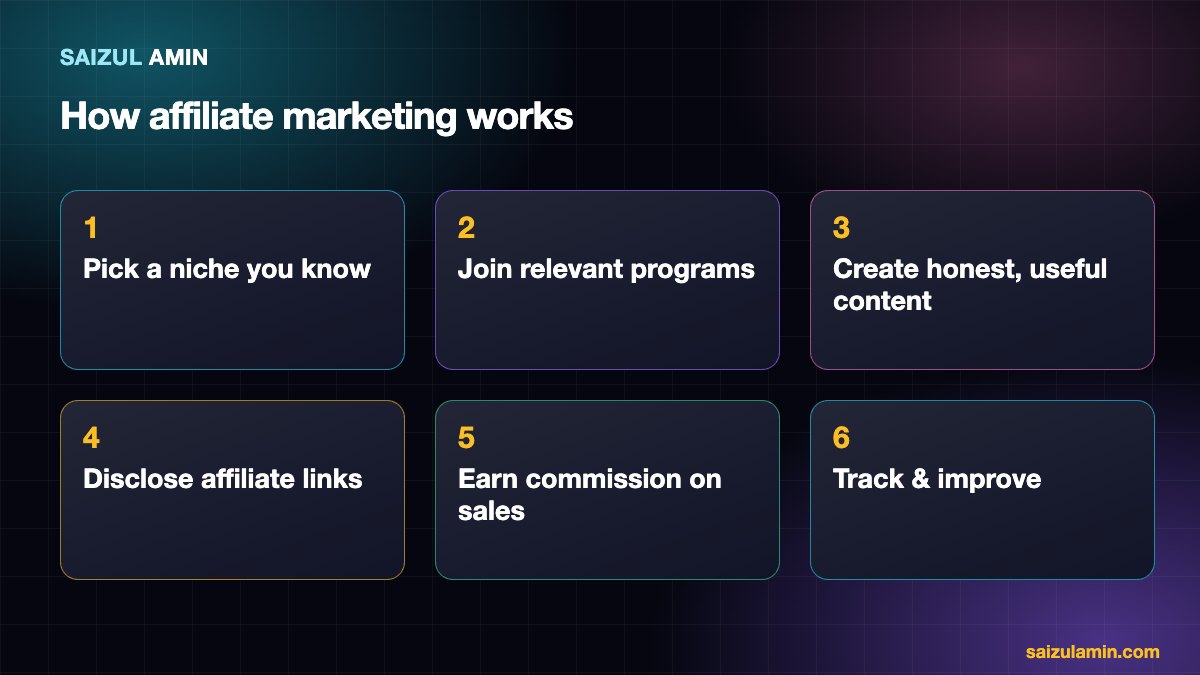
How affiliate marketing works
- You join an affiliate program (directly with a company or through a network) and get tracking links.
- You publish content that helps a reader decide: a review, comparison, tutorial or “best for” list.
- A reader clicks your link; a cookie or tracking parameter records the visit.
- If they buy within the program’s tracking window, you earn a commission, which can be a percentage or a fixed amount, and sometimes recurring.
Choose a niche you actually know
Pick a topic where you have real experience or can build it, where people research before they buy, and where products have affiliate programs. Credibility is the product you are really selling. A niche like “website hosting for small businesses” works if you have set up sites and can explain the trade-offs; “everything on Amazon” does not.
Where to find programs
- Company programs: many software, hosting and course companies run their own.
- Networks: Impact, CJ, ShareASale-style marketplaces and regional networks list many merchants.
- Marketplaces: Amazon Associates and similar, with low commissions but trusted brands.
Read the terms: commission rates, cookie length, payout thresholds, what is forbidden (for example bidding on brand keywords) and whether you may use their logos.
Content that earns clicks and trust
| Content type | Reader intent |
|---|---|
| Honest product review (with pros, cons and who it is not for) | Decision stage |
| Comparison (A vs B) | Choosing between options |
| “Best X for Y” list with your testing criteria | Shortlisting |
| Tutorial that uses the product | Learning and solving a problem |
- Show first-hand evidence: your screenshots, results, costs and experience. Google’s guidance on writing high-quality reviews is worth reading.
- Explain how you evaluated and be clear about limits.
- Mark affiliate links as such for search engines (
rel="sponsored"), as Google recommends in its link best practices.
Disclose your affiliate relationships
In many countries, including the US, you must clearly tell readers when you may earn from a link. Place the disclosure close to the link, in plain language (for example, “If you buy through my link I may earn a commission at no extra cost to you”). See the FTC’s Disclosures 101. Many programs also require it in their terms. This is both a legal and a trust issue.
Getting traffic
- SEO: the most durable source. See my SEO roadmap.
- Email: an audience you own converts best; build a list early.
- Video and social: useful for demonstrations and reach.
- Avoid shortcuts such as buying traffic or spamming links; they harm your accounts and reputation.
What to expect
Income is slow at first. Most beginners earn little or nothing for months while they build content and trust. Treat it as a long-term asset, and consider combining it with other models; see how to make a website that makes money and content monetization strategies.
Common mistakes
- Promoting products you have not used or understood.
- Thin pages that only repeat the product description.
- Hiding affiliate links or disclosures.
- Choosing programs only for the highest commission, regardless of quality.
- Relying on one program or one traffic source.
Need a second pair of eyes?
If you would like help applying this to your own website, send me a message with your site address and goal. I will tell you honestly what I would do first.
Frequently asked questions
Is affiliate marketing free to start?
Joining programs is usually free. You will need a place to publish (a website, channel or newsletter) and time.
Do I need a website?
Not strictly, but a site you control with helpful content is the most stable foundation.
Can I use AdSense and affiliate links together?
Often yes, if both comply with their policies and the page stays reader-friendly.
How much can I earn?
It ranges from nothing to a full-time income. Results depend on niche, trust, traffic and the quality of your content.
Sources and further reading
- FTC: Disclosures 101 for Social Media Influencers
- Google Search Central: Link best practices (affiliate links)
- Google: Review content guidance
How this article was written
I wrote this guide from hands-on experience with websites, SEO and automation. Technical and policy details were checked against the official sources above in October 2026. Tools, policies and prices change; if you notice something out of date, email info@saizul.com and I will correct it. Examples reflect my own projects and will vary on yours.

Saizul Amin is a digital growth strategist and SEO consultant specialising in search engine optimisation, web development, AI-powered automation, and online income systems. With 8 years of hands-on experience helping businesses and individual creators grow their online presence, Saizul combines technical expertise with practical, results-driven strategy.
Experience & Background
Saizul started his digital career in 2017, initially working with Bioscope Limited to build and optimise websites for organic search traffic. Over the years, he has worked across industries including DGHS, NAVANA, UNICampus, UNIPathways, UniqueMark, developing a deep understanding of what it takes to rank, convert, and grow sustainably online.
His work spans the full digital stack — from technical SEO audits and content strategy to WordPress development, marketing automation, and AI tool integration for small businesses and startups.
What He Covers on This Blog
Every article on SaizulAmin.com is written from direct experience. Saizul does not publish theoretical content — every guide, tool recommendation, and strategy shared here has been tested and applied in real projects. Topics include:
- Search engine optimisation (on-page, technical, and content SEO)
- Digital marketing strategy and growth systems
- AI tools and automation for business productivity
- Web development, WordPress, and website building
- Making money online through freelancing and affiliate marketing
Why Trust This Content
All recommendations on this site reflect tools and strategies Saizul actively uses or has personally evaluated. Where affiliate relationships exist, they are clearly disclosed. Content is regularly reviewed and updated to reflect current best practices and algorithm changes.