

Updated October 2026. I’m Saizul Amin, a digital growth and web systems professional working on websites and SEO since 2017. I have rewritten this guide from scratch with practical steps, tested advice and sources, and I will keep it current. Last reviewed: October 2026.
If you create content (articles, videos, newsletters, podcasts), the order in which you monetise it matters more than the method. Add income too early and you damage trust before you have an audience; wait too long and you leave value on the table. This guide gives you a sensible order, with the trade-offs of each step.
For a comparison of how entire websites earn, read how to make a website that makes money. This article focuses on creators and publishers who start from an audience.
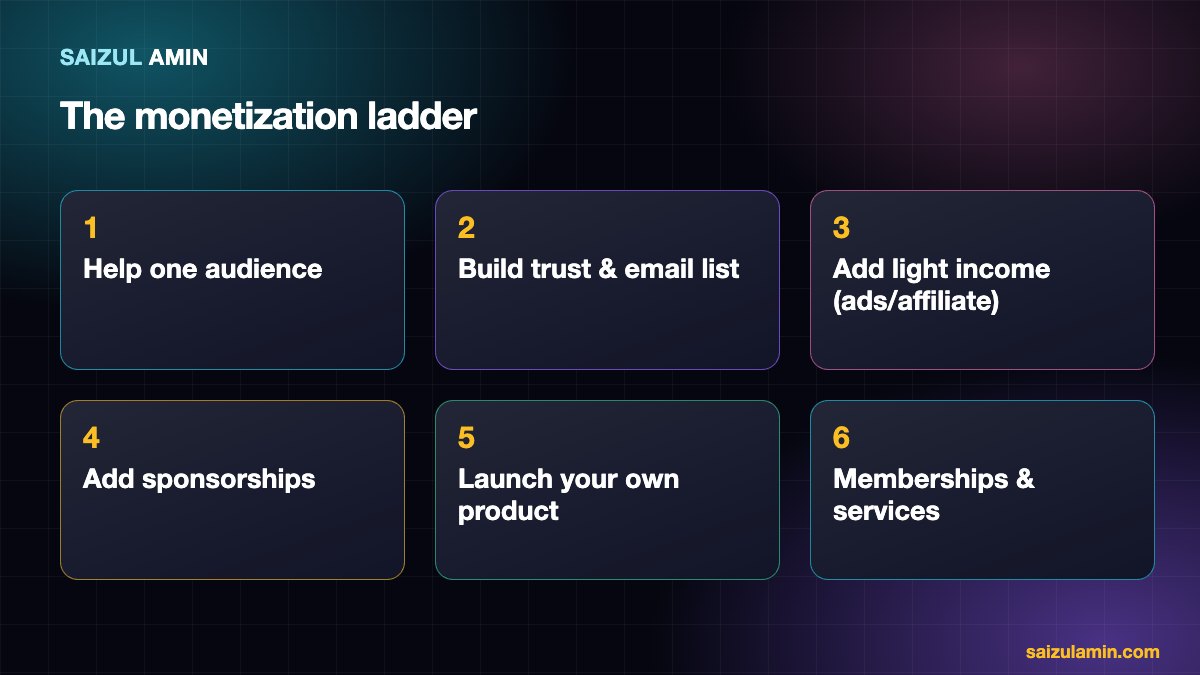
Rung 1–2: Help one audience and own the relationship
Nothing sells without attention and trust. Pick a narrow audience, solve their recurring problems and publish consistently. Capture an email list early: unlike social followers, you own it, and it converts better than almost any other channel.
Rung 3: Light monetisation with ads and affiliate links
- Display ads need substantial traffic to matter and must follow the AdSense Program policies. See my approval checklist.
- Affiliate links suit tutorials, reviews and comparisons. Only recommend what you have used or evaluated properly, and disclose the relationship clearly. See affiliate marketing for beginners.
These are low effort per article but their income is modest and depends on traffic you do not fully control.
Rung 4: Sponsorships
Once you have a focused audience, brands may pay for sponsored posts, newsletter slots or partnerships. Quote on the value of reaching a specific, engaged audience, not just numbers, and always label sponsored content.
Rung 5: Your own products
Templates, guides, courses, presets, small tools. This is where margins and control rise. Build what your audience already asks you for, validate with a pre-sale or waiting list, and keep the first version small. My list of platforms to sell digital products can help you choose where to sell.
Rung 6: Memberships and services
Paid communities, premium content, coaching, consulting and done-for-you services convert deep trust into higher-value income. Often the best “monetisation” of a content site is the client work it brings in. Content proves your expertise; services get paid for it.
Choosing a mix
| Stage | Sensible focus |
|---|---|
| 0 to 1,000 regular readers | Quality, email list, maybe affiliate links where genuinely useful |
| Steady search or social traffic | Ads, affiliate, first small product |
| Engaged niche audience | Sponsorships, memberships, services |
Protect trust while you earn
- Never let income dictate the recommendation. Do not promote what you would not use.
- Keep ads and promotions separate from editorial advice.
- Maintain clear privacy and disclosure pages.
- Do not buy traffic or use click schemes.
Track the right numbers
- Revenue per 1,000 visits (RPM) by source.
- Email subscribers and their conversion rate.
- Time on page and returning visitors, as signs of trust.
Need a second pair of eyes?
If you would like help applying this to your own website, send me a message with your site address and goal. I will tell you honestly what I would do first.
Frequently asked questions
What is the easiest way to monetise content?
Affiliate links and ads are the easiest to start but earn the least per effort until traffic is high. Services usually pay fastest if you have a skill to sell.
How big should my audience be?
A small, engaged, well-targeted audience can earn more than a large generic one, especially for sponsorships and products.
Do I need a website?
A site you own gives you control and search visibility; combine it with an email list.
How do I avoid losing trust?
Be transparent, recommend honestly and put the reader’s interest first.
Sources and further reading
- Google AdSense Program policies
- FTC: Disclosures 101 for Social Media Influencers
- Google: Creating helpful, people-first content
How this article was written
I wrote this guide from hands-on experience with websites, SEO and automation. Technical and policy details were checked against the official sources above in October 2026. Tools, policies and prices change; if you notice something out of date, email info@saizul.com and I will correct it. Examples reflect my own projects and will vary on yours.

Saizul Amin is a digital growth strategist and SEO consultant specialising in search engine optimisation, web development, AI-powered automation, and online income systems. With 8 years of hands-on experience helping businesses and individual creators grow their online presence, Saizul combines technical expertise with practical, results-driven strategy.
Experience & Background
Saizul started his digital career in 2017, initially working with Bioscope Limited to build and optimise websites for organic search traffic. Over the years, he has worked across industries including DGHS, NAVANA, UNICampus, UNIPathways, UniqueMark, developing a deep understanding of what it takes to rank, convert, and grow sustainably online.
His work spans the full digital stack — from technical SEO audits and content strategy to WordPress development, marketing automation, and AI tool integration for small businesses and startups.
What He Covers on This Blog
Every article on SaizulAmin.com is written from direct experience. Saizul does not publish theoretical content — every guide, tool recommendation, and strategy shared here has been tested and applied in real projects. Topics include:
- Search engine optimisation (on-page, technical, and content SEO)
- Digital marketing strategy and growth systems
- AI tools and automation for business productivity
- Web development, WordPress, and website building
- Making money online through freelancing and affiliate marketing
Why Trust This Content
All recommendations on this site reflect tools and strategies Saizul actively uses or has personally evaluated. Where affiliate relationships exist, they are clearly disclosed. Content is regularly reviewed and updated to reflect current best practices and algorithm changes.