

Updated October 2026. I’m Saizul Amin, a digital growth and web systems professional working on websites and SEO since 2017. I have rewritten this guide from scratch with practical steps, tested advice and sources, and I will keep it current. Last reviewed: October 2026.
Freelancing pays when you combine a skill that clients value with the ability to find work, set clear terms and deliver reliably. Most beginners focus only on the first part. This guide covers all three, based on my years working with clients on websites, SEO and automation.
Skills that tend to earn well
| Skill area | Examples of paid work | Notes |
|---|---|---|
| Web development | Business sites, WordPress, web apps, fixes and speed work | Steady demand; portfolio is key. See the roadmap |
| SEO and digital marketing | Audits, content strategy, local SEO, ads management | Results-driven; case studies matter. See my SEO roadmap |
| Writing and editing | Articles, website copy, technical writing | Specialising in a subject raises rates |
| Design | Branding, social graphics, UI design | Clear process and revisions policy needed |
| Video editing | Reels, YouTube, promos | Consistent turnaround wins repeat work |
| Automation and AI | Workflow automation, chatbots, data processing | Growing demand; see AI automation for business |
| Virtual assistance and admin | Inbox, scheduling, research, data entry | Low barrier; reliability is the product |
The business skills most beginners skip
- Clear communication: confirm scope, timelines and what you need from the client in writing.
- Estimating and pricing: charge for the value and time, including revisions and communication.
- Contracts and payment terms: a short agreement, a deposit for larger jobs, and clear invoicing.
- Time and project management: deadlines, updates and saying no to scope creep.
- Selling: describing the result you create, not only the tasks you perform.
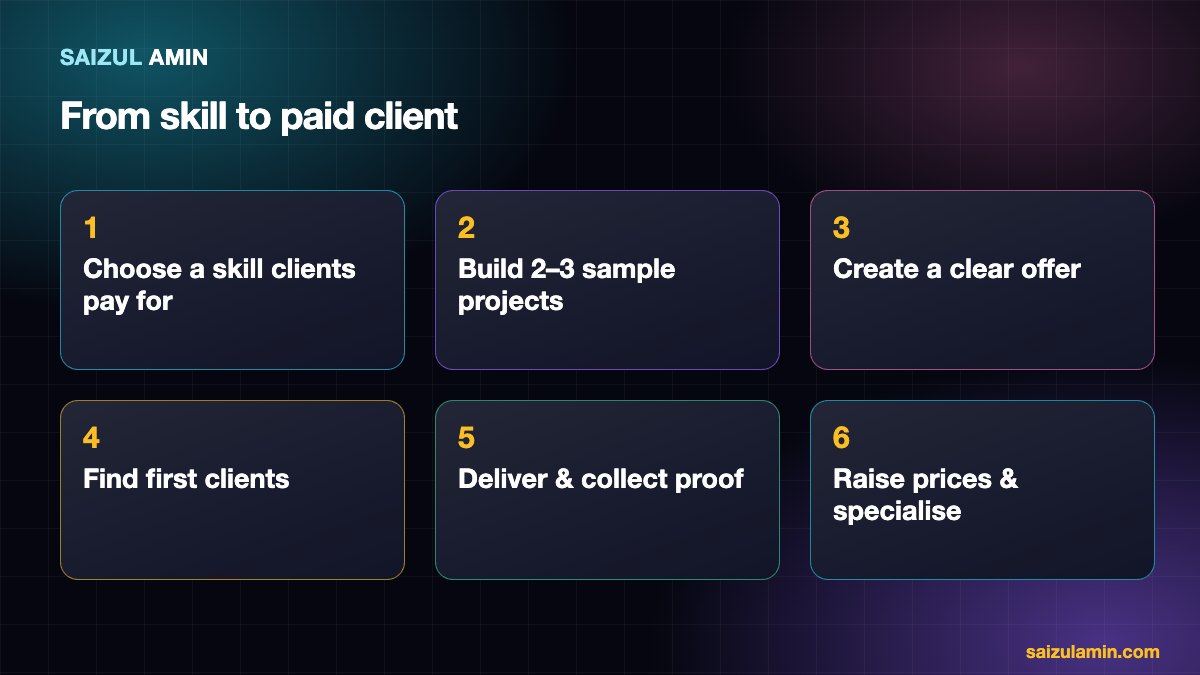
Create a clear offer
“I do web design” is vague. “I build fast, SEO-ready WordPress websites for dental clinics in Dhaka in two weeks” is something a client can say yes to. Define who you serve, the result, the process, the timeline and a starting price or range.
Build proof before you have clients
- Create two or three sample projects that show real work (a mock project for a local business, a case study of improving a site’s speed, a sample audit).
- Publish them on a simple portfolio site with the problem, your approach and the result.
- Collect testimonials from your first clients, with their permission.
Where to find your first clients
- Your network: friends, former colleagues and local businesses often become the first clients. Tell people exactly what you do.
- Marketplaces such as Upwork and Fiverr: competitive, but they teach you how clients buy. Write specific proposals that address the client’s problem, not copy-paste templates. See the platforms’ own help resources before you start.
- Content and search: useful articles and a good portfolio bring inbound work over time. My guide on getting your first client as a web developer goes deeper.
- Outreach: a short, personalised message pointing out a specific problem on a business’s site and how you would fix it.
Pricing without undercharging
- Do not compete only on the lowest price; you attract the hardest clients.
- Price by project when the scope is clear, and by hour or retainer when it is ongoing.
- Add a margin for revisions, meetings and unexpected issues.
- Raise rates as your portfolio and testimonials grow.
Common mistakes
- Working without a written scope or deposit.
- Saying yes to everything, then missing deadlines.
- Having no niche, so nothing you say is memorable.
- Depending on a single client or platform.
- Stopping learning. Tools and client needs change quickly.
Beyond one-off projects
Once you have repeat clients, turn work into recurring services (maintenance, monthly SEO, reporting), build reusable assets (templates, processes) and consider productising your expertise. See content monetization strategies for ideas.
Need a second pair of eyes?
If you would like help applying this to your own website, send me a message with your site address and goal. I will tell you honestly what I would do first.
Frequently asked questions
Which freelancing skill is best for beginners?
The one that matches your interests and where you can produce visible results quickly: web development, writing, design or virtual assistance are common starting points.
How long until I get my first client?
It varies from days to several months, depending on your network, offer and effort. Proof and outreach speed it up.
Do I need a degree?
Clients mostly care about results, samples and reliability.
Is freelancing stable?
It can be, if you diversify clients, build recurring work and keep a financial buffer.
Sources and further reading
- Upwork: Resources for freelancers
- Fiverr Help Center
- Google: Search Essentials (for web and SEO freelancers)
How this article was written
I wrote this guide from hands-on experience with websites, SEO and automation. Technical and policy details were checked against the official sources above in October 2026. Tools, policies and prices change; if you notice something out of date, email info@saizul.com and I will correct it. Examples reflect my own projects and will vary on yours.

Saizul Amin is a digital growth strategist and SEO consultant specialising in search engine optimisation, web development, AI-powered automation, and online income systems. With 8 years of hands-on experience helping businesses and individual creators grow their online presence, Saizul combines technical expertise with practical, results-driven strategy.
Experience & Background
Saizul started his digital career in 2017, initially working with Bioscope Limited to build and optimise websites for organic search traffic. Over the years, he has worked across industries including DGHS, NAVANA, UNICampus, UNIPathways, UniqueMark, developing a deep understanding of what it takes to rank, convert, and grow sustainably online.
His work spans the full digital stack — from technical SEO audits and content strategy to WordPress development, marketing automation, and AI tool integration for small businesses and startups.
What He Covers on This Blog
Every article on SaizulAmin.com is written from direct experience. Saizul does not publish theoretical content — every guide, tool recommendation, and strategy shared here has been tested and applied in real projects. Topics include:
- Search engine optimisation (on-page, technical, and content SEO)
- Digital marketing strategy and growth systems
- AI tools and automation for business productivity
- Web development, WordPress, and website building
- Making money online through freelancing and affiliate marketing
Why Trust This Content
All recommendations on this site reflect tools and strategies Saizul actively uses or has personally evaluated. Where affiliate relationships exist, they are clearly disclosed. Content is regularly reviewed and updated to reflect current best practices and algorithm changes.