

Duplicate URLs are normal: tracking parameters, sorting options, HTTP and HTTPS versions, printer pages. The canonical tag tells search engines which version you prefer. It is a hint, not a command, and Google combines it with other signals.
From my own work: In audits I often find canonicals pointing to redirected or noindexed URLs, or every paginated page canonicalised to page 1. Both waste the signal or hide content.
What rel=canonical does
<link rel="canonical" href="https://www.example.com/blue-shoes/" />It suggests the preferred URL for a set of duplicates (Google canonicalization, RFC 6596). Google may choose another URL if other signals disagree; the URL Inspection tool shows the “Google-selected canonical”.
Practical rules
- Use self-referencing canonicals on every indexable page.
- Use absolute URLs with the correct protocol and host.
- Point to a URL that returns 200, is indexable and is not redirected.
- Keep one canonical per page, in the
<head>. - Make internal links, sitemaps and hreflang use the same canonical URL.
Parameters and filters
Tracking (?utm_) and sort parameters should canonicalise to the clean URL. Filtered category pages with real search demand can be indexable with their own canonical; low-value combinations should canonicalise to the parent or be blocked from crawling.
Pagination
Each paginated page should canonicalise to itself, not to page 1, so products or posts on deeper pages can be discovered (pagination guidance).
Syndicated content
If partners republish your article, ask them to add a cross-domain canonical to your original or to noindex their copy.
WordPress
WordPress core and SEO plugins output self-canonicals automatically. Override per post only when needed (Yoast: Advanced → Canonical URL). Check theme or page builder duplicates such as attachment pages.
Debugging
Compare “User-declared canonical” and “Google-selected canonical” in URL Inspection, and see indexing issues and robots.txt: never block a URL whose canonical you want Google to see.
Want this done on your own server or site?
I am Saizul Amin, a web developer and technical SEO consultant. I set up and harden VPS servers, migrate WordPress sites, fix indexing problems and build automations. See my portfolio or get in touch.
FAQ
Canonical or 301 redirect?
Use a 301 when users should not see the old URL; use canonical when both URLs must stay accessible.
Can I canonicalise to another domain?
Yes, cross-domain canonicals are supported, for example for syndicated content.
Why does Google ignore my canonical?
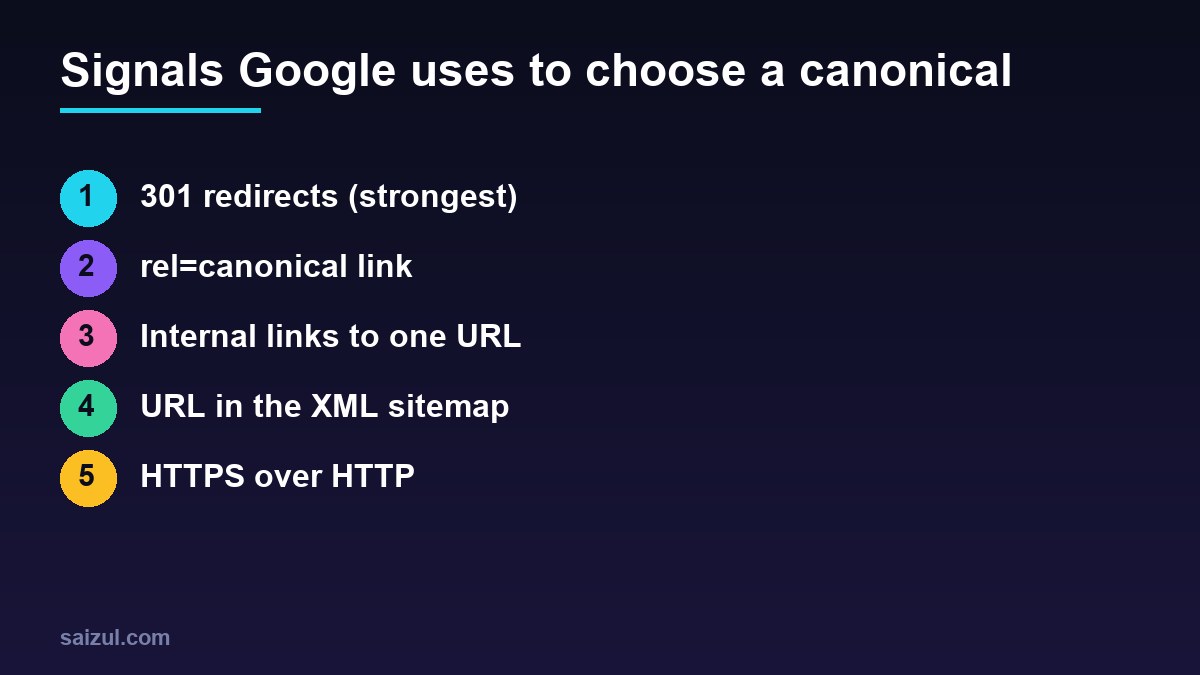
Conflicting signals: internal links, sitemaps, redirects or content differences point elsewhere.
Sources
- Google: What is URL canonicalization
- Google: How to specify a canonical URL
- Google: Pagination best practices
- RFC 6596: The canonical link relation

Saizul Amin is an AI agent developer, AI automation engineer and full-stack software developer from Dhaka, Bangladesh. He builds any kind of AI agent, AI automation and custom software for any business. Portfolio: https://saizul.com